

ROMANIA, UP CLOSE

Romania joined NATO in 2004, the European Union in 2007, and the Schengen Area in 2025. Income levels have climbed quickly across that period and infrastructure has improved with them, though unevenly and with plenty still to do.
The country sits on NATO's southeastern flank and has begun to take this position increasingly seriously. Defence spending remains consistent and military infrastructure is being built out across several sites. For buyers, this translates in practice to ownership sitting within a stable EU legal framework and Schengen making travel in and out trivial. The rules themselves change often, and 2026 brought several: VAT on new build rose to 21%, off-plan purchases gained new protections, and minimum company capital went up. The framework is solid. The detail is worth checking before you sign anything.
Daily life is safe. Violent crime is low by European standards and lower still in the mountains, and the sorts of urban problems that shape life in Western capitals don't really figure here outside Bucharest.
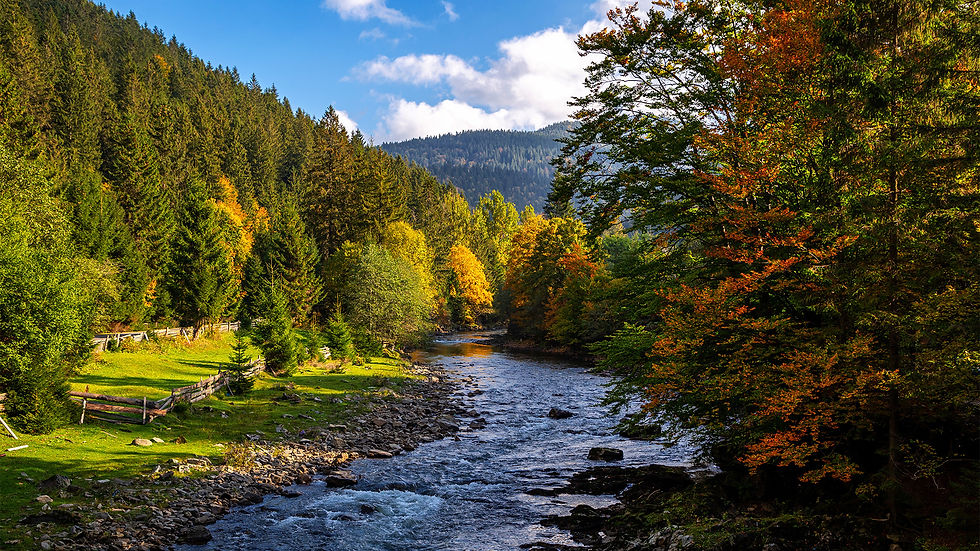
Climate remains a major draw. The Carpathians still hold real winters with reliable snow at high altitudes. Few places are immune to the overall climate change, but here summers are still cool enough to warrant a fire in the evening, even in August when the southern plains can reach forty degrees. The mountain microclimates sit an hour or two from major cities, which means you can easily evade the summer heat.
Getting in is straightforward, with direct, low-cost flights from most of Western Europe to Bucharest, Cluj, Timișoara, Iași, Sibiu, Brașov, and Târgu Mureș. From Bucharest, the southern Carpathians are a few hours by car; from Cluj, the Apuseni are even closer.
Optic fiber in Romania is among the fastest in Europe and sometimes reaches into rural areas, so working remotely from a mountain property remains entirely practical. Culturally, the country carries layered marks from Ottoman, Habsburg, and Orthodox worlds, most visibly in village architecture and in how the houses and churches are laid out around a centre.
This picture varies, of course. Some areas have been overbuilt, some forests have been pressured hard for decades, and, as is common throughout Western and Eastern Europe, some villages are losing people faster than they can replace them. In much of Western Europe, the landscape has been settled for generations, and the choices were made then. Romania is one of the last places in the EU where that remains an open question.
For a deeper dive and some numbers:
ROMANIA IN BRIEF
BUYING PROPERTY IN ROMANIA

ROMANIAN CARPATHIANS

The Carpathians cross Romania for roughly 900 kilometres, and over that distance they change character many times. The painted monasteries and wooden churches of Bucovina and Maramureș share a country with the volcanic chain of the Eastern Carpathians and with the Hungarian-speaking villages of Ținutul Secuiesc that sit beside it. The mountains of the Carpathian Bend hold sandstone caves and mud volcanoes within a short drive of each other. The Southern Carpathians, Romania's highest, rise above a patchwork of historical lands: Țara Bârsei (the Land of Bârsa), Țara Sașilor (Saxon Land), Țara Făgărașului (Făgăraș Country), and Țara Hațegului (Hațeg Country), each with its own specific tradition, its own architecture, and its own local economy. In the Apuseni, the Moți live in scattered hilltop hamlets where the nearest neighbour may be half a kilometre away. The Banat speaks several languages in its oldest churches. Sometimes, changes can be seen from one village to the next.
Climate, building style, food, religion, road quality, and winter length all shift as you move through the range. Where you settle in the Carpathians matters, because each sub-range and even valley can be very different. Below are 5 regions as we think about them, although many locals would question any classification of this nature.
-
NORTHERN CARPATHIANS — Maramureș & Bucovina
-
EASTERN CARPATHIANS — Volcanic Chain, Calimani, Ținutul Secuiesc and Western Moldova
-
CARPATHIAN BEND — Vrancea, Buzău, Ciucaș
-
-
Țara Bârsei, Țara Sașilor, Țara Făgărașului, Prahova Valley
-
Mărginimea Sibiului & Țara Hațegului
-
-
-
Apuseni Mountains — Țara Moților
-
Banat Mountains — Semenic, Cerna Valley, Iron Gates
-