

THE NORTHERN RANGES
- NOBS - human curated AI research

- Apr 22
- 2 min read
Updated: Apr 29
MARAMURES AND BUCOVINA
The northern end of the Carpathian arc holds two of the most distinct regions in Romania. Maramureș in the west, Bucovina in the east, separated by the Maramureș Mountains and the Rodna ridge.
This is where the cultural layer is thickest. Wooden churches built in the 1600s still hold Sunday services. The painted monasteries of Bucovina are still working communities. In some valleys, people still farm with horses. Not for show, but because it works.
Mountains
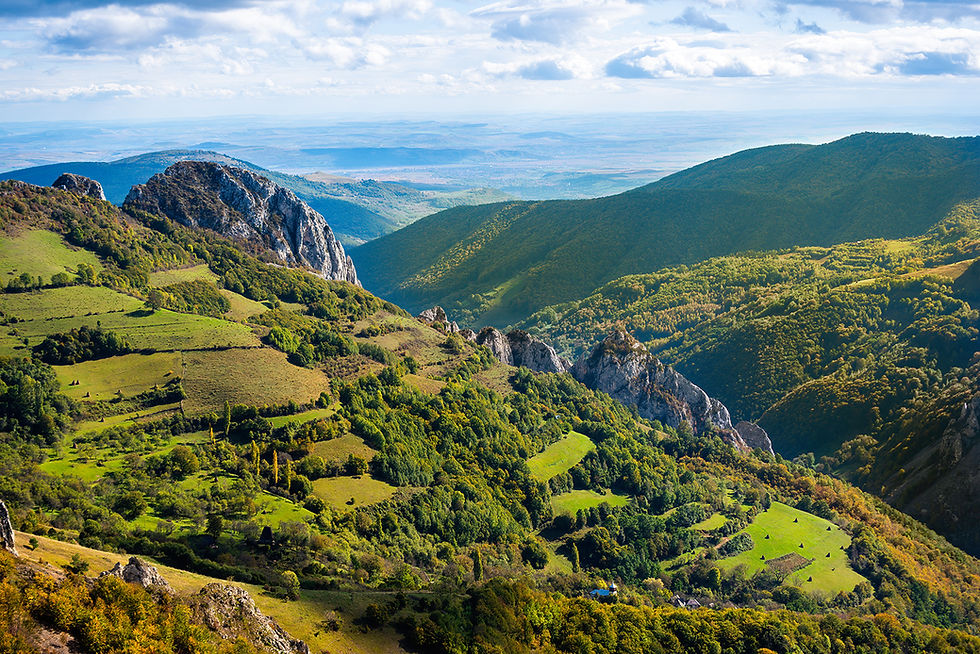
The Rodna massif holds the highest peaks of the Eastern Carpathians, inside one of Romania's largest protected areas. On the Bucovina side, the terrain softens into the rounded massifs of Giumalău and Suhard, with the Rarău mountains standing out for their dramatic limestone formations known as the Lady's Stones.
Hubs
In Maramureș, the main anchors are Baia Mare and Sighetu Marmației, with Borșa as the mountain base. In Bucovina, they are Suceava, Gura Humorului, and Vatra Dornei. Distances between valleys take longer than the map suggests.
Villages
Some are well-kept and adapting. Others are slowly emptying. This is a lived landscape, not a preserved one. The cultural depth is real, but it is uneven from one valley to the next. A village fifteen kilometres from a busy tourist route can feel a century away.
Access
Most international visitors fly into Cluj-Napoca and drive three to four hours north. Suceava has its own airport with limited connections. Winters are long and properly cold. Summers are mild and green.
For Those Who
This region suits those who value cultural depth and quiet over convenience. Property prices are among the lowest in the Carpathians, but liquidity is also lower. Distances from major cities are longer. Services depend on where you land.
What you get in return is a part of Romania that has not been shaped by mass tourism. For the right person, it tends to matter more the longer you stay.
Reality Check
The north is authentic because it is remote, and it is remote because it is far from everything. In winter, a heavy snow can close a secondary road for a day. In some villages, the nearest hospital is forty-five minutes away. Internet has reached most places, but not all. The famous villages (Breb, Botiza, Ciocănești) have become busier and more expensive in recent years, while neighbouring valleys a few kilometres away remain almost untouched. The gap between the two can be surprising.
None of this is a reason to stay away. It is a reason to visit in person before you decide anything.
Useful Regional and Cultural Websites
Maramureș County Tourism: https://www.cjmaramures.ro/turism
(Romanian only)
Suceava County Tourism (Bucovina): https://turism-suceava.ro/ (Romanian only)
UNESCO Wooden Churches of Maramureș: https://whc.unesco.org/en/list/904/
UNESCO Painted Churches of Moldavia: https://whc.unesco.org/en/list/598/
Mountains and Nature
Rodna National Park: http://www.parcrodna.ro/ [Romanian, limited English)
Mocănița Vișeu de Sus: https://www.cffviseu.com/
(Romanian only)
Vatra Dornei Tourism: https://www.primariavatradornei.ro/
(Romanian only)


Comments